
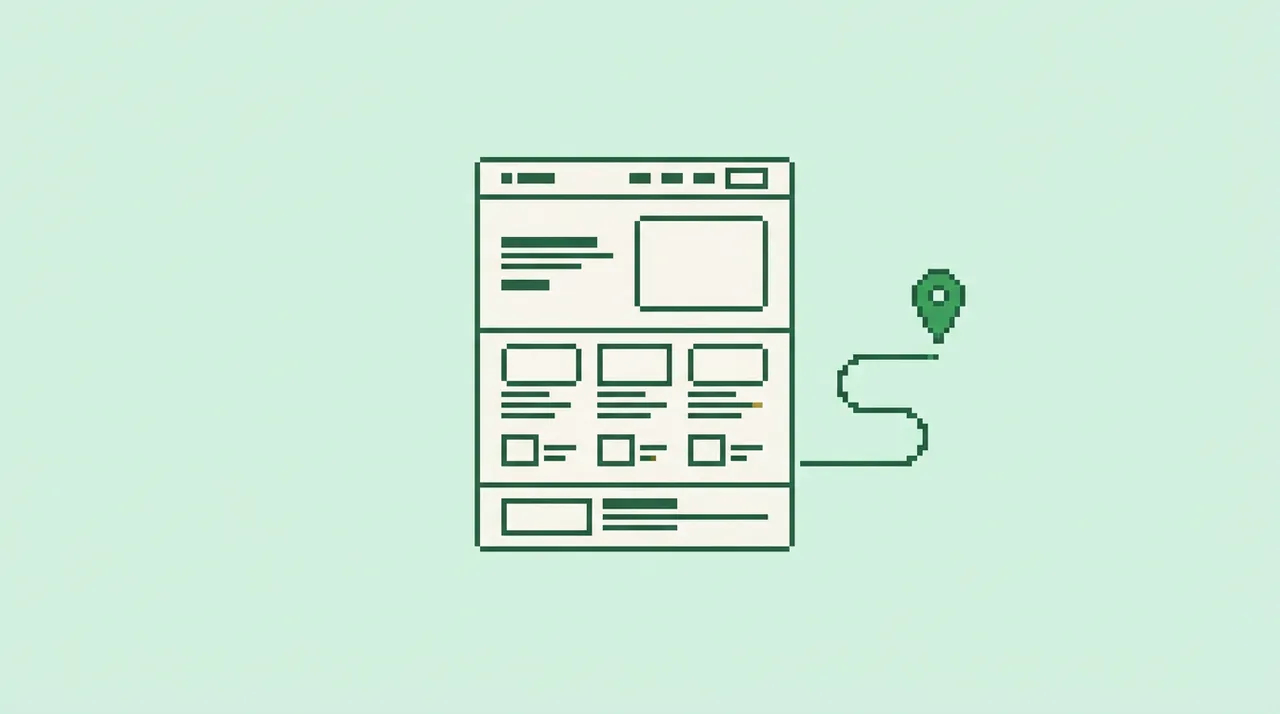
Local landing pages can help Google Maps visibility when they prove that a business serves a place or solves a local problem. They can also become thin doorway pages if every city page says the same thing with a different city name.
The difference is not the URL. The difference is usefulness, proof, and specificity.
In this guide
Short answer
Build local landing pages only when you can make the page genuinely useful for that location, service, or customer segment. The page should support the Google Business Profile with clear services, local proof, reviews, photos, FAQs, and conversion paths — not just repeated keywords.
When a local landing page is worth creating
A page is usually worth creating when at least one of these is true:
- the location has a real office or team;
- the service area has meaningful demand;
- customers in that area ask different questions;
- you have local reviews, photos, projects, or proof;
- competitors have strong location-specific pages;
- the GBP needs stronger website support for a priority service.
If none of those are true, a new page may be noise.
The local landing page checklist
| Section | What it should prove | Weak version |
|---|---|---|
| Hero | Who you help, where, and with what service | Generic “best service in city” headline |
| Service detail | What the customer can actually buy | Thin keyword paragraph |
| Local proof | Reviews, jobs, photos, team, neighborhoods | No evidence beyond city name |
| Map/area clarity | How the business serves the area | Confusing or exaggerated coverage |
| FAQs | Real local buying objections | Generic SEO filler |
| CTA | Clear next step | Hidden phone/form |
| Internal links | Related services and nearby locations | Orphan page |
Avoid doorway-page signals
Be careful with pages that:
- swap only the city name;
- use identical testimonials everywhere;
- claim offices that do not exist;
- show no local proof;
- target every suburb with near-duplicate copy;
- exist only for search engines, not customers.
A safe page answers a real buying question. A risky page exists only to catch a keyword.
What to fix first
Before writing ten new pages, audit the pages you already have:
- Do priority service pages mention the city/service clearly?
- Does the GBP website link point to the best supporting page?
- Are calls/forms visible above the fold?
- Are reviews and proof tied to the offer?
- Are weak pages competing with stronger pages?
Often the first win is improving one core service page, not publishing a batch of thin local pages.
Example
A plumbing company wants to rank in three nearby suburbs. Instead of copying one “plumber in city” page three times, it can create one strong service-area hub plus specific sections for emergency plumbing, water heaters, reviews from nearby customers, and service-area details. If one suburb has enough proof and demand, then a dedicated page can be justified.
How SEOG helps
SEOG can compare GBP signals, website support, competitor pages, and content gaps. It can show whether a ranking issue looks like a GBP field problem, a website support problem, a review proof problem, or a weak local-page problem. That makes the next content task more precise.
FAQ
Are local landing pages bad for SEO?
No. Thin, duplicated doorway pages are the problem. Useful local pages with real proof can support local visibility.
How many local pages should I create?
As many as you can make genuinely useful and maintain. For many small businesses, that is fewer than they think.
Should the GBP link to a local landing page?
It can, if that page is the best match for the listing and customer intent. Test carefully and avoid constant switching.
Bottom line
A local landing page should help a customer decide, not just help a keyword exist. If the page proves the offer and supports the profile, it is an asset. If it only swaps city names, it is a risk.
A page-quality test before publishing
Before a new local page goes live, ask five questions:
- Would a customer in this area learn anything useful?
- Does the page show proof that the business serves this area?
- Is the service offer clearer than on the generic page?
- Is the CTA specific and easy to use?
- Would you still keep this page if search engines did not exist?
If the answer to the last question is no, the page probably needs more substance.
What makes a local page worth keeping
Useful local pages often include:
- a service-area explanation;
- local reviews or project examples;
- photos from real work or team context;
- specific service constraints or response times;
- common questions from that area;
- internal links to related services;
- a clear phone/form path.
None of these require keyword stuffing. They require proof.
SEOG action output
For each local page, SEOG-style reporting should show:
| Recommendation | Meaning |
|---|---|
| Improve | Page has value but lacks proof or CTA |
| Consolidate | Page overlaps another stronger page |
| Build | Search demand and proof justify a new page |
| Hold | Not enough unique value yet |
| Remove/noindex review | Thin page creates more risk than value |
This makes local content planning safer and easier to explain.
Related SEOG guides
- Local SEO Client Onboarding Checklist: What Agencies Should Audit in the First Week
- Local Marketing Software Checklist: What Small Businesses Need Before They Add Another Dashboard
- Local SEO Agency Reporting Checklist: What Clients Need to See Each Month
- Local SEO vs Search Engine Marketing Checklist: Which Budget Fixes Local Visibility First