
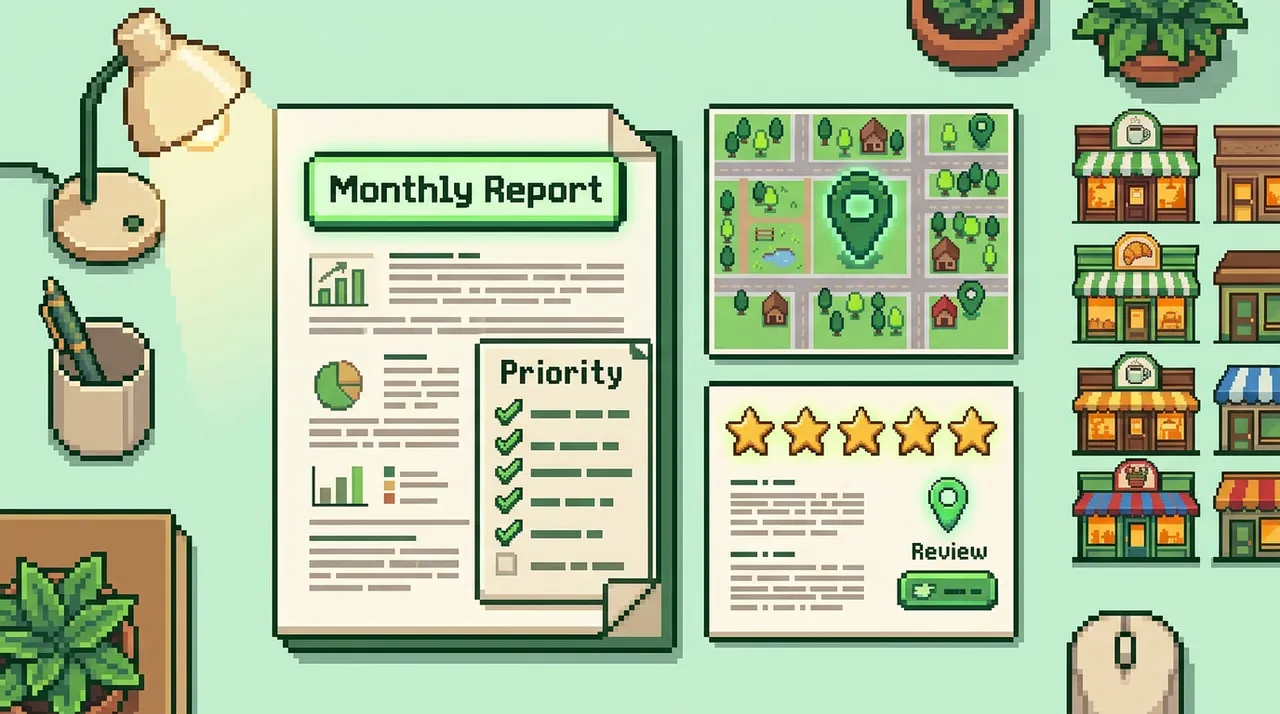
A local SEO report should not be a screenshot dump.
Clients need to know what changed, why it matters, what you recommend next, and what is safe to touch. A good monthly report turns rankings, reviews, competitors, website support, and Google Business Profile signals into decisions.
Start here: if the client asks “what did we get this month?”, the report should answer with priorities, not vanity metrics. If you want a SEOG-style first pass, run a free local visibility analysis →.
In this guide
Short answer: what a monthly local SEO report should include
| Section | What it should answer |
|---|---|
| Executive summary | What changed and what matters now? |
| Google Business Profile status | Is the profile healthy, complete, and safe? |
| Maps/local visibility | Where did visibility improve or drop? |
| Calls/actions | Are clicks, calls, bookings, and website visits moving? |
| Reviews | Are rating, count, freshness, and replies improving? |
| Competitors | Who moved up, and why might they be winning? |
| Website support | Do pages support target services and locations? |
| Next actions | What should we fix first next month? |
The buyer moment: “What is my agency actually doing?”
Local SEO clients usually do not want raw dashboards. They want confidence.
They ask:
- Are we getting more calls?
- Why did rankings move?
- What did competitors do?
- Are reviews helping or hurting us?
- What should we fix next?
- Which work is complete?
- What is blocked by Google, the client, or the website?
A useful report answers those questions in plain language.
What not to include as the main report
| Weak report habit | Why clients dislike it |
|---|---|
| 30 pages of screenshots | Hard to understand and easy to ignore. |
| Ranking grids without explanation | Shows movement but not meaning. |
| Only positive metrics | Reduces trust when the client sees problems elsewhere. |
| No next actions | Leaves the client unsure what happens next. |
| Generic SEO advice | Does not connect to the specific business. |
Monthly report framework
1. Executive summary
Lead with the decision story.
Example:
- Calls from Google slowed this month.
- Profile status is healthy.
- Review velocity is down compared with two competitors.
- Website service page is weak for the target query.
- Next priority: review request workflow + service page support.
2. GBP health
| Check | Report language |
|---|---|
| Status | Live / verified / issue detected. |
| Categories | Primary category still matches target search. |
| Hours | Accurate for customer expectations. |
| Services | Key services represented without spam. |
| Photos/posts | Freshness and relevance. |
| Risk fields | Name/address/service-area changes needing caution. |
3. Reviews and trust
| Review metric | Why it matters |
|---|---|
| Review count | Social proof vs competitors. |
| Rating | Conversion and trust. |
| Freshness | Whether the business looks active. |
| Reply rate | Owner responsiveness. |
| Themes | What customers praise or complain about. |
4. Competitor movement
Do not just say “competitor outranks us.” Explain likely causes.
| Compare | What to look for |
|---|---|
| Categories | Are they more relevant? |
| Reviews | More/fresher/better replies? |
| Website pages | Stronger location/service content? |
| Proximity | Are they closer to searcher/map center? |
| Photos/profile completeness | Better trust signals? |
Fast path: a good agency report separates what is under your control from what is not. That is the difference between “rankings changed” and “here is the next decision.”
How SEOG helps agencies
SEOG can turn scattered local SEO signals into an action-oriented client report.
| SEOG output | Agency use |
|---|---|
| GBP audit | Show profile health and risk. |
| Visibility gaps | Explain where rankings/calls may be weakening. |
| Competitor comparison | Show why another business may be winning. |
| Review queue | Identify replies and review momentum issues. |
| Website support check | Connect Maps visibility to landing pages. |
| PDF-ready action plan | Give clients a clear next-step report. |
FAQ
Should a local SEO report include rankings?
Yes, but rankings should be explained with context: location, query, competitors, profile changes, and conversion impact.
Should clients see every technical detail?
Not in the main summary. Keep the main report decision-focused and add technical detail only where it supports an action.
How often should agencies report?
Monthly is common. Urgent profile issues, suspensions, or review crises should be reported faster.
Can SEOG replace an agency report?
SEOG can support the reporting workflow, but agency judgment still matters. The best report combines data, context, and a clear next action.
Make the report useful enough to act on
A strong local SEO report does not just prove work happened. It helps the client decide what to fix next.
Start free business analysis →
Related SEOG guides
- Local SEO Client Onboarding Checklist: What Agencies Should Audit in the First Week
- Local Search Analysis Checklist: What to Check Before You Buy Another SEO Tool
- Local SEO Audit Software Checklist: What Agencies Should Check Before Client Reporting
- Local SEO Pricing Checklist: What to Check Before You Hire an Agency or Buy Software