
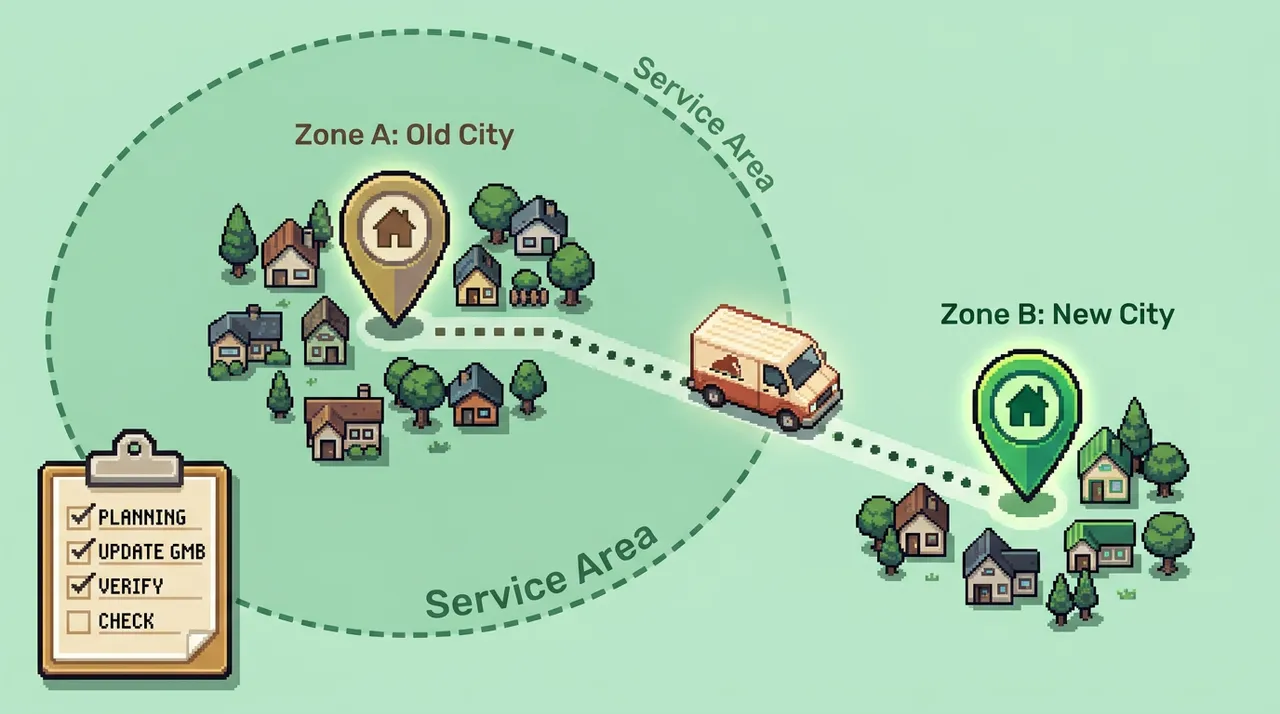
If your service-area business is moving cities, do not treat the Google Business Profile update like a simple address edit.
A move can affect verification, map visibility, service-area relevance, reviews, citations, website pages, and customer trust. The safest plan is to separate what changed in the real world from what should change inside Google.
Start here: map the move before editing the profile. Confirm the old market, new market, service area, website support, reviews, citations, and verification risk. If you want a first pass, run a free SEOG analysis →.
In this guide
Short answer: what to check first
| Priority | Check | Why it matters |
|---|---|---|
| 1 | Real-world move details | Google changes should match the actual business operation. |
| 2 | Current profile status | Do not make risky edits if verification is already unstable. |
| 3 | Address vs service-area setup | SABs have different risk than storefronts. |
| 4 | Website location support | The site should explain the new market clearly. |
| 5 | Review and customer history | Reviews may support old geography more than new geography. |
| 6 | Citations/NAP | Major listings should not contradict the new entity/location. |
| 7 | Competitor map | The new market may require a different visibility plan. |
The buyer moment: “Can I move my profile without losing rankings?”
A service-area business may move from one city to another and still serve the old area, or it may fully relocate. Those are different problems.
Before editing, answer:
- Is the business still serving the old market?
- Is there a new physical address?
- Is the address customer-facing or hidden?
- Did the business name or phone number change?
- Are reviews mostly tied to the old city?
- Does the website have a new location/service page?
- Are citations already updated?
- Are competitors stronger in the new area?
What not to change first
| Do not start with | Why to be careful |
|---|---|
| Changing address without evidence | May trigger verification or trust checks. |
| Expanding service areas aggressively | Can look like overreach if the website and signals do not support it. |
| Creating multiple city profiles | Risky unless each location is eligible and real. |
| Rewriting the business name for the new city | Keyword/location stuffing can violate guidelines. |
| Deleting old pages too quickly | You may remove relevance that still supports leads. |
Relocation scenarios
| Scenario | Safer first step |
|---|---|
| Same business, new city, hidden address | Audit current status and update website support before profile edits. |
| Same business, still serving old city | Clarify service areas and landing pages. |
| New storefront location | Gather address proof and update profile carefully. |
| Business changed name and market | Treat as entity-change risk, not a simple move. |
| Multiple real locations | Use multi-location model only if each location is eligible. |
Website checklist for the new market
Your website should support the move before or alongside profile changes.
| Website element | What to confirm |
|---|---|
| Contact page | Name, phone, service area, and location language are consistent. |
| Service pages | Core services are still clear for the new market. |
| Location page | The new city/region is explained naturally. |
| Internal links | Blog/service pages point users to the right market. |
| Schema/meta | Location language is accurate and not spammed. |
| Old market pages | Keep or redirect based on actual service coverage. |
Fast path: if the move is already live and leads dropped, do not keep editing. Audit current visibility, then choose whether the next fix is website support, citations, category/service cleanup, or Google profile evidence.
How SEOG helps
SEOG helps turn a messy relocation into a prioritized local visibility plan.
| SEOG output | What it helps decide |
|---|---|
| Current GBP status | Is it safe to edit now? |
| Local visibility map | Where are you visible now vs the new target market? |
| Website support check | Does the site prove the new market? |
| Citation/NAP review | Which external listings contradict the move? |
| Competitor comparison | What will it take to compete in the new city? |
| Priority action plan | What to change first, what to delay, what to avoid. |
FAQ
Can a service-area business move to a new city and keep rankings?
Sometimes, but rankings are not portable like a file transfer. Google evaluates relevance, distance, prominence, and trust in the new context.
Should I hide my address?
If customers do not visit your address, follow Google’s service-area guidance and avoid showing a non-customer-facing location.
Should I build a new location page?
Usually yes, if the new market is real and important. The page should be useful and specific, not a thin city keyword page.
Can SEOG change the profile automatically?
No. SEOG should guide the audit and action plan. Sensitive GBP changes should be reviewed by a human.
Plan the move before you edit
If your business is changing cities, the goal is not to make the most changes. The goal is to make the right changes in the safest order.
Start free business analysis →
Related SEOG guides
- Map Pack Competitor Analysis Checklist: Why They Rank Above You and What to Check First
- Google Business Profile Optimization Software Checklist: What to Check Before You Subscribe
- Home Services Local SEO Checklist: How to Match Your Dispatch Area to Google Maps Demand
- Multi-Location Local SEO Audit Checklist: What to Standardize Before You Scale